Thursday, January 28, 2010

Your People Call Them Vampires


But he, straining for no more than a glimpse
of hearth-smoke drifting up from his own land,
Odysseus longs to die...

My heart swells at the thought of home, my own Ithica, page 498. But there's a long way to go yet, comrades. Take heart!

... And one more thing. And really this could have happened to anybody, an honest mistake, but something to keep in mind and a lesson for everybody and one we should all take to heart- Twelfth Mate "Cheeky" James Bailey (recently demoted), has pointed out that my own personal Calypso is not, in point of fact, when all things are considered, summed up, and put into a neat and tidy row, named Stephenie Meyers, but rather Stephenie Meyer. Like I said, honest mistake. I'm not even going to try to save face in some preposterous manner and pretend I thought the novel was written by committee or something, or that she is Legion. No, no, I just wasn't paying attention. This ought not in any way reflect upon the credibility or rigor of my efforts.

That settled, let's um... sally forth or something and get a move on. Rough seas ahead.

Chapter 5
Blood Type
and
Chapter 6
Scary Stories
And
Chapter 7
Nightmare

If I may vent some frustration at this point. The invitation made by Edward to drive Bella to Seattle is made in Chapter 4. Presumably on this trip something awesome, violently vampire-esque, or both is going to happen. Three chapters and a solid 70 pages later, they haven't gone yet. No one has died, and there is a definite lack of mood-setting, darkly gothic ambience. Not even an Igor with a hump on his back and loads of stitches, who answers everybody's requests with an exaggerated 'Yeth, maaaarth-ter'. (That's asking a bit much, I admit.) I'm losing my vampire motivation, my BLOOD drive, if you will... har har. It's all being sucked away (get it?) by these sorts of exchanges:

I had to look away from the intensity of his stare. I concentrated on unscrewing the lid of my lemonade. I took a swig, staring at the table without seeing it.
"Aren't you hungry?" he asked, distracted.
"No." I didn't feel like mentioning that my stomach was already full- of butterflies. "You?" I looked at the empty table in front of him.

...
...
...

Precisely.

But we won't get anywhere complaining and lolligagging about. Here's what happens. Bella comes to school and she gets invited to sit next to Edward at lunch, and here we enjoy the already cited repartee. They flirt outrageously (all three senses: it is too much, it is very strange, and I am outraged), and Bella faints in science class because blood is being drawn. Edward saves her by seducing the secretary so Bella can get out of school.

Afterwards, Bella goes on a camping trip and meets an Indian boy named He-Who-Advances-Plot or Squawking-Foreshadow or something. Anyway Running-Gag tells Bella that the Cullens aren't allowed on Indian ground... because they're vampires! Hooray! Someone finally says it!

So Bella of course gets depressed and franticly researches vampires... on the internet. Yes, the internet. If you must, go ahead and google 'vampires'. (Please, filters on for this one.) How many credible resources sprang up? Anything that reassured you that here, finally here, you might find a sober, academic approach full of gravity and reason? Well, Bella does. She discovers the following:

Stregoni benefici: An Italian vampire, said to be on the side of goodness, and a mortal enemy of all evil vampires.

She finds this very reassuring. Oh, and then she has a nightmare.

Now, this Stregoni Benefici is apparently an actual mythological figure and not of Stephenie Meyer's creation. Or at least several websites claim so. Obviously, if there is any credence to this story, we would have to look through Italian history for some powerful figure, some knight of goodness, who stands out in a unique way. Could it be Da Vinci? I doubt it, too much of an egghead. Dante? What a ponce! Garibaldi? Please. We may never know who the real Stregoni Benefici is, but let's just say I have my theories.


Best sentences:
- His voice was like melting honey.
-"I love them," I enthused, making an effort to smolder at him.
-... but there was no sign of Edward or any of his family. Desolation hit me with crippling strength.

Monday, January 18, 2010

Woolfing it Down

For she could stand it no longer. Dr. Holmes might say there was nothing the matter. Far rather would she that he were dead! She could not sit beside him when he stared so and did not see her and made everything terrible; sky and tree, children playing, dragging carts, blowing whistles, falling down; all were terrible. And he would not kill himself; and she could tell no one.
-Virginia Woolf, Mrs. Dalloway

Of course he wasn't interested in me, I thought angrily, my eyes stinging- a delayed reaction to the onions. I wasn't interesting. And he was. Interesting... and brilliant... and mysterious... and perfect... and beautiful... and possibly able to lift full-sized vans with one hand.
-Stephanie Meyers, Twilight

If I really did have to describe Stephanie Meyers right now, I would say she's like Virginia Woolf, minus her sensibilities, competency and feminism, but plus vampires. Now, I''m no... (Woolfian? Woolfite? Woolfeur? Considering the subject matter I'm going in a different direction.)

Now, I'm no Woolf-man, but I have done several minutes worth of research on the global repository of human knowledge that is Wikipedia. Virginia Woolf, as it turns out, was among the writers who pioneered a narrative stream-of-consciousness technique in the early twentieth century along with fellows like Joyce and Faulkner. And there are times when Stephanie Meyers sounds a bit like her.

I am aware there are people with English degrees reading this, so nobody get their aesthetics in a twist just yet. Here's the similarity. Woolf is the only one of those three I mentioned whose style of stream-of-consciousness narration is both purposefully melodramatic and purposefully feminine. I say purposefully feminine because she had political and social reasons for taking on what she considered a feminine voice (she was a favorite of the early feminist movement). I say purposefully melodramatic because I've felt a rather strong undercurrent of irony in how she depicts the wild mood-swings of her characters. Stephanie Meyers of course isn't so subtle or accomplished, but the narration absolutely draws upon the stylistic influence of writers like Woolf, Joyce, and Faulkner. (Everybody does. Their influence is ubiquitous and subconscious; I doubt strongly Meyers is modeling herself after them on purpose.)

Meyers uses stream-of-consciousness of a sort, and if it sounds like anybody, it sounds like Virginia Woolf. Stephanie Meyers character Bella certainly is feminine, in the most culturally stagnant, stereotypical sense, and my God, is that poor girl melodramatic. Reading her mind (the narration is first-person) is like reading the prose equivalent of a mood-ring stuck on a mad she-chimp in heat.

Bella and Edward.

She might be insane:

Grrr.
-Stephanie Meyers, Twilight

I rest my case. Anyway, here's the chapter synopsis:

Chapter 4
Invitations

I'll give you three guesses to figure out what happens in this chapter. Got it? That's right! Bella gets invited to the school dance. Repeatedly. And that's what happens in this chapter. This chapter is about Bella being invited to the school dance no less than three times. The school dance. This is a vampire novel, by the way.

So she tells them all she's going to Seattle that weekend, and (gasp!) Edward invites her to go with him and the curtain closes. It's a date!

Here are the best sentences (the two from above are out of chapter 4 also):

-"You're welcome," he retorted.
-I tried to be crafty as I hid my horror.
-Stupid, shiny Volvo owner.
-His eyes were gloriously intense as he uttered that last sentence, his voice smoldering. I couldn't remember how to breathe.

See? Just like Virginia Woolf.

Wednesday, January 13, 2010

A Heaping Pile of Seconds

Oi... the first chapter was rough going, but I'm back for more and (secretly) enjoying myself in a perverse sort of way. Like a QT hotdog eating contest with extra jalapeno relish. I'm doing a two-fer here because you really don't want 24 separate blog posts about this.

Chapter 2
Open Book
and...
Chapter 3
Phenomenon

I'm justifying doing these two together for two reasons. First, like I said, this ought to be as short and merciful as possible, and second, nothing much happens in these chapters. Bella continues to narrate the story like a 40-year old divorcee (did I mention this? 16-or-whatever-she-is year olds don't talk like this: "It was ridiculous, and egotistical, to think that I could affect anyone that strongly."), and the story is moving along without much of anything happening. These two chapters first really introduce Edward as a character and that's about it. And boy is he... something.

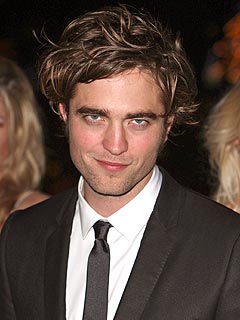
I can't really say what I thought at first, to be honest. I was only introduced to Twilight when the movies came out and this face:


began to harass me every time I went to the check-out line at Krogers. He's the only thing I picture when I read about Edward Cullen, and I have to give the casting director for the movies some props here; Robert Pattinson is terrifying.

"I would like to eat your flesh."

I honestly do believe that he could be a vampire. Really, if he approached me I'd genuflect, and run to the nearest table and break off a leg so I could defend myself, Ron Artest-style. (If you don't get the reference, you will if you keep reading my posts about the NBA. That story will come up eventually.) Anyway, he's honest-to-goodness, poo-in-the-pants scary, and he's the only thing I saw reading these last two chapters. I was a little distracted to say the least.

My synopsis: Bella goes to school, already obsessing about Edward for some reason, but he's not there. He continues not to be there until he shows up again a couple weeks later looking rather less sallow. Presumably he's eaten someone.

"With some Fava beans and a nice Chianti. Fu-fu-fu-fu."

He then proceeds to be genuinely friendly and interested in her. She, in turn, proceeds to instantly fall in love. In the next chapter, it snows some, Bella complains like its the end of her freaking world, and she almost (almost!) dies in a car crash. Except Edward saves her.

And that's about it. I did, however, manage to unearth this gem of a sentence:

"I made the Cowardly Lion look like the terminator." (pg. 30)

Until next time!

"Don't turn out the lights!"

Further Reading:
The Onion Twilight Article

Sunday, January 10, 2010

Roundball Semiotics: Basketball qua Jazz


What Fats is saying of course, and this ought to be sufficiently demonstrated by the sax solo at least, is the nearly axiomatic and essential truth: Jazz = Basketball, Basketball = Jazz.

The analogy has reached the cultural saturation point that even though I can't recall who first suggested it to me, or even if any one person in particular suggested it to me, I still associate on a guttural and more or less involuntary level (read: thoughtlessly) the game of basketball with the musical form Jazz. Certainly someone thought of the analogy first, but he's long faded into the background and morphed into an assumption. I've seen it sometimes criticized, because really, what else do bloggers have to do all day? But much more commonly it rests serenely in the background as an unconscious archetype by which we understand the game.

If you think about it too hard though, there are likely a host of racial subtexts and attitudes, possibly ugly ones, which contribute to the idea. Most of which I don't have the heart to explore except to comment on how telling it is that we're still surprised when white people engage in either activity. Sometimes with reason.
But then sometimes not; we all know Django had style, and Larry Bird is Larry Bird. Nonetheless, I think we find it much easier to accept the association of basketball with a stereotypically "black" art form like jazz or (increasingly) hip-hop than we do with an oppositely characterized "white" art form such as, say, baroque chamber music. But that's beside the point. The question is, does the analogy shed any kind of light on the nature of basketball in its own right? Would the analogy still work without all the race-issue boogeymen mucking up the picture?

First the argument. I think it is commonly stated that Basketball = Jazz for the following reasons.
1. Basketball and Jazz are both, at least in theory, a series of improvisations set within an ideal structure. In this sense, an A#7 to Fm7 chord progression is something like the high screen and roll, although possibly less emphatic.

>
2. Said improvisation is at its best when cooperative. There are solo jazz performances of course, just like there are isolation plays in basketball, but both Jazz and Basketball are, I believe, at their most fascinating and most fully realized when the individual talents of the players merge in a skillful synergy, a sort of hive-mind gestalt.

3. Although this may apply more appropriately to Football (Soccer), there is also the continuity and flow of the game. In theory, if the refs aren't a little too chippy with the whistles, or if one of the teams isn't coached by Jeff van Gundy, Basketball is a game where the back-and-forth, give-and-take pace can take on the liquid contours of some of the more lengthy Jazz odysseys.


So far so good. The previous three points are the three I see made most commonly, and certainly, they all have their salient merits. What I don't ever really see, but which I submit for your consideration as point number 4, is something I hope will strengthen the analogy beyond the merely coincidental.

4. At least since the early eighties, upon the dawn of the Larry Bird v. Magic Johnson rivalry, and culminating finally in the Michael Jordan Era (MJE, a dating system based upon the ascension of Jordan into the league. We are, for example, in year 25 MJE) the game of basketball has always been extremely character driven in a way I think is highly reminiscent of Jazz.

Defense: More than most musical forms before it, I suggest Jazz was a star-driven art form. I don't simply mean in how it grew commercially, I mean in how it developed stylistically from catalytic influences of highly talented individual musicians like ole' Fats or Dizzie Gilespie. In many ways, Jazz artists failures can be attributed as much to their inability to cultivate interesting public personae as much as any lack of skill. Kenny G, remember, can circular breath ad infinitum, which truly is impressive... But does it matter?


I suggest basketball is similar. It's development has always been driven by individual talents more than basketball theorists like the coaches or owners. I hold this to be true of more than just the NBA by the way. Any pick up game you go to will always feature at least one very talented player trying to leave his own stamp on the game in his own way.

Basketball and Jazz are both extremely individualistic, even during moments of cooperation. The assist is as much of an opportunity to impress yourself upon the game as any other, and under this light, we could think of Basketball as an unexpectedly apt expression of Schopenhauer. Of course Jazz isn't competitive, so it's right about here that the analogy breaks down (as all analogies must), but Jazz remains extremely character-driven, and if we had to stretch things way too far, we could suggest that the performance is a kind of Schopenhauerian attempt to impress one's personality upon the song. But that would be ridiculous.

All right then kiddos! There's the first of my ramblings about basketball. Up next? Basketball teams as wine. But whatever else happens, remember: Basketball = Jazz, Jazz = Basketball.


Whyyy helloooooo theeeere (Resolutions)

The most productive thing I have done with my two "cold days" off from teaching (The cynics among my readership will at this point cry "Well, it certainly hasn't been posting on your blog like you promised" -- feedback duly noted) has been to start a book my father gave me for Christmas called Caring for Words in a Culture of Lies. I plan on posting a full review when I finish, but I wanted to offer some reflections it has provoked in me so far.

We live in a culture which worships speed and efficiency. If I don't get my hamburger 30 seconds after ordering, I sigh and tap my foot and wonder what the world's come to. Sadder still, I rage, rage (and sometimes even curse) when the Internet -- the Internet! -- fails to load at a speed commensurate with my oh so important and hectic schedule. Hello, my name is Asher, and I am addicted to speed. (My lawyer counsels that at this point I pause to clarify with utter certitude that I mean speed as in alacrity, not speed as in the harmful drug -- especially since some of my students apparently have started to read this.)


(Not the author of this post)

The truth is, I live for instant gratification. Anything short of immediacy burdens me with its inconvenience. The past few years I have consistently chosen ease over the more rewarding path. My immediate reaction on sitting down on my couch is, I am sad to say, not to reach for a book but to grab the computer or remote.

My main resolution (much as I disdain the term) then is to simply slow down my life. Thankfully the process has already begun. Since getting married, I have become preoccupied with cooking as a leisure activity. I have always enjoyed cooking, but what I have discovered is the joy present in slow deliberation in the kitchen, in taking the time to do things well. Eschew short cuts in the kitchen -- they rarely pay off. The long simmering sauce is (in general) the most flavorful and rewarding. My guru in this has been Robert Farrar Capon, author of the strange yet wonderful cookbook/food memoir/spiritual meditation Supper of the Lamb (a book I am hoping to review alongside Andrew in our first real collaborative effort for this blog). In the book Capon warns against "tin fiddles", contraptions which promise to take the work out of cooking. But remove the labor and you lose not only taste but the very essence of cooking. Good cooking is a process which takes time; not only takes but gives, gives time for reflection, meditation, that simmering of the mind and hands which gives off a heavenly aroma.

So I am slowing down the way I produce food (and also, hopefully, the rate at which I eat it. I am a notorious, self confessed scarfer. Some primordial urge prods me to wolf down food at an alarming rate. This year I pledge to slow down the process, to truly savor each bite I take in to my body). But food is far from the only area which merits the cultivation of better habits. Caring for Words has confronted me with the need to treasure and savor the words I use. Too often I take the path of least resistance, fall back on lazy usage, pick an adequate word instead of the perfect word. My thought, speech, and writing are dwarfed versions of what they could be if I took the time to be contemplative.

Lectio Divina is the monastic practice of reading through Scripture contemplatively, of pausing in places to really suck the meaning from the verses as a dog worries a bone. I love to read Scripture, even to study it, but I rarely take the time to let it sink deeply into my life. Therefore lectio divina is an important part of my resolution for the year. Hand in hand with this is the need to create areas of silence in my life. Confession: silence makes me uncomfortable. When I encounter silence I feel like I have slammed into a wall: I emerge with my nose out of joint and feeling altogether put out. But silence, pure deep silence, is a precious gift. One of my favorite quotes comes from Kierkegaard's Journal, where he says:

The present state of the world and the whole of life is diseased. If I were a doctor and were asked for my advice, I should reply: Create silence! Bring men to silence. The Word of God cannot be heard in the noisy world of today. And even if it were blazoned forth with all the panoply of noise so that it could be heard in the midst of all the other noise, then it would no longer be the Word of God. Therefore create silence.

Silence creates the space we need for grace to act. Create silence. But, having created silence, speak. Conversation is another part of my resolution. Conversation which moves and breathes deeply, conversation which blows the dust off of our lives and dives in deep to the inner places. I desire to take the time to really know people, not rush through my interactions with them at a hurried pace. Extended face time tends to make me twitchy or unsettled, but this year I resolve to take the time to listen, really listen, and to speak when the time is right. To invite people into my life in ways that matter. To appreciate the slow winding of a conversation that takes a few hours to find its real center. People and relationships matter so much more than whatever small, self-centered agenda I have set for the day.

These then are my resolutions. Really they united in one purpose: helping me slow down my world, which spins so fast that I am constantly thrown off balance. Will you, my readers, help as I stubbornly devote myself to this task?

Thursday, January 07, 2010

Maybe There Was a Glitch in My Brain

My wife Jenny and I were once stranded in Oklahoma City for a day, and spent much of it hanging out at a Borders pretending we might buy things. I took the time to read through the graphic-novel Watchmen for the first time (a rewarding experience) and Jenny sat down with a copy of Twilight. (And I would like to preempt any snarky comments about us using Borders this way; we were bored, out of cash, and eventually did make a minor purchase.)

Now, admittedly, we spent a good, oh, six hours at the Borders cafe, but in that amount of time Jenny managed to read through the entire first novel (498 pages) and its sequel (576). In one day. Not just one day, in six hours Jenny managed to read well over 1000 pages of teen vampire drivel. She couldn't stop, like a speed-reader literally on speed. I made fun of her. She claimed to hate them. But of course, once we returned to Tulsa, Jenny found someone who owned the other two Twilight novels and devoured them at a similar pace. What gives?

What, indeed, gives? I have taken it upon myself to find out, and have determined to do what I thought I never would. I'm going to read Twilight. And liveblog my thoughts... Here goes!

Chapter 1
First Sight

I have to admit, I was a little excited to read this. I'm a snob and everybody knows it, but I love vampires, and am secretly glad of the opportunity to read the book while pretending to have ulterior motives for doing so. Anyway, I was surprised right off to find an epigraph from Genesis gracing the first page.

But of the tree of the knowledge of good and evil,

thou shalt not eat of it:
for in the day that thou eatest thereof
thou shalt surely
die.
Genesis 2:17

This, if it makes sense of nothing else, at least makes sense of the front cover:


Ahh. That's why there's an apple. I detect a theme! I don't really know what it means at all yet, but I'm sure something or other forbidden will be offered at some point. We'll see.

The first chapter features our quirky, sassy heroine Bella leaving her hometown Phoenix to live with her estranged father in a sunless bit of Washington called Forks. (As in, a Forks in the road?) Anyway, she's extremely moody and sad, and chapter one details her anxiety driven first day at school. She doesn't fit, and cries a bit. There's also a preface in which somebody called the hunter tries to kill her... while sauntering. I assume only a vampire could accomplish this. Some of the writing is a little odd. My favorite sentences:

"The hunter smiled in a friendly way as he sauntered forward to kill me." (preface)
"And I never looked a free truck in the mouth- or engine." (pg 7)
"I wasn't in the mood to go on a real crying jag." (pg 9)
"Maybe there was a glitch in my brain." (pg 11)
"I glanced sideways at the beautiful boy, who was looking at his tray now, picking a bagel to pieces with long, pale fingers." (pg 20)

They love bagels.

And the absolute best? Bella muses to herself as she approaches her new school:

"I can do this, I lied to myself feebly. No one was going to bite me." (pg 14)

Get it!? Do you get it!? Like a vampire!

Sadly though, no one did. But I'm a writer, and those of us who are in the Biz (as we call it) refer to this technique as Foreshadowing.

But really, it isn't so bad as I'm making it out to be, and if I were forced to be entirely honest, I would have to admit that I kinda sort of am enjoying myself. Like I said, I dig vampires.

I wonder what happens in chapter 2!

Turn and Face the Strange

Loyal readers will notice that there have been a few changes around the ole blog. Thanks to my wonderful (and technologically advanced) wife, I have a new template which I hope will liven things up a bit. Commenting on my previous template, Leslie had this to say "It's depressing and boring I don't want to read it." So there you go.

Appropriate, I suppose. I realized that the last few posts (since I've come back to semi-regular blogging) have been very ponderous, if not downright glum. That is certainly one side of who I am, but far from a complete picture. When I first started writing, my intention was to chronicle all things cultural; of late I have left a very large portion untouched. I hope to return to those things. In that spirit, I have come into the 21st Century and added a "gadget" to the site, albeit a gadget which mimics an arcade game from the 80's. Burger Time is perhaps the greatest classic arcade game, and reflects part of my taste: the goofy side which values silly pop culture oddities. If you need a break from my ramblings, just scroll down to the bottom of the page to relieve stress by being chased around by sociopathic hot dogs.

The most important change, however, is the addition of a new friend. As you may notice, this blog now has two contributors. In addition to me, TEP will now feature my good friend Andrew. Cheesemonger by day, novelist by night, Andrew currently lives with his wife and adorable baby daughter in Dallas, Texas. He has a sharp mind (and wit), and fills in some cultural blind spots: he promises to write about the NBA, among other things -- something I enjoy but am not particularly knowledgeable about. He also pledges to give to the site his silly side, which he swears is his best. I believe his first post will be a blow by blow account of him wrestling with that noted literary classic, Twilight. I feel sure that we can expect great things from him.

As for my rascally self, I will do my best to put up a new post tomorrow.

Maiden Voyage

Ahoy! to all (five? six?) readers of Asher's much storied blog. this is the maiden post of The Erstwhile Philistine's first second blogger ever! I haven't thought of any clever title's yet, so I'm going with my usual handle (Andrew, if you don't know me).

Credentials: Before I ever met Asher I did in fact enjoy the novel pleasures of a category we might call the... "less-than-competent". My tastes ran primarily to the B-grade Kung-Fu variety, but was not averse to the B-grade in general. However. I must admit this amateurish habit was inflamed by Asher himself into a kind of passion approaching (if only asymptotically) the level of everyone's beloved Philistine. I have witnessed R.O.T.O.R. and survived. I have eaten peanut-butter-and-scrambled-egg sandwiches and enjoyed. I am competent to comment, or I like to think so. In any case I can run my mouth with the best of them.

Also: Yes, I am working on a series of posts on the Twilight novel, and yes, eventually I will write about basketball.

Tuesday, December 29, 2009

Just a Note

I got a little spam (of a nasty variety) in the comments section of the last few posts, so I am getting rid of Anonymous comments and putting up a word verification system. Sorry, I know that is annoying, but it is for all our good.

Monday, December 28, 2009

Far As the Curse is Found...

A very merry late Christmas to all two of you who read this thing. I had every intention of posting this post before Friday, but as usual all my good intentions went out the window in the bustle of pre-Christmas movement: family and food and wrapping presents and... not to mention Ryan and Tori's wedding two days before (as a side note, let me say how wonderful it is to be at a wedding just before Christmas -- it helps put me in the right frame of mind). So here it is, in all its delayed glory.

Anyone intimately acquainted with me knows that I am a fanatic for Christmas carols. It is a love inherited from my mother (and shared by my sister), a passion which directs itself in various odd directions. As a result, I have a vast knowledge of Christmas carols, both famous and obscure. Add to this my natural tendency towards arrogance, and the resulting alloy can be best described as a certain amount of carol snobbery. In general my tastes run toward the soulful and minor, and away from the maudlin and treacly. Accordingly I have developed a rather fixed rating system. My basic premise is that most carols we typically sing at Christmas are vastly overrated (that piece of festering crap known as "Away in a Manger", which is only slightly improved when sung to the vastly superior British tune), while a handful are criminally underrated ("Let All Mortal Flesh Keep Silence"). Of course there is a whole raft of wonderful songs which exist in a category well beyond underrated, closer probably to undiscovered. Hands down my favorite Christmas song is "Of the Father's Love Begotten", which is versatile enough to be sung at any time of the year but somehow gets neglected. Then there are the precious few which seem to be rated just right. A minor miracle of the season is that we sing "O Come O Come Emmanuel" as much as we do -- it is easily the best of the super-popular carols.

This post is not really about any of those categories or songs. It is about a new category, one I saw fit to invent myself this holiday season (granted, I suppose I invented the whole system, but bear with me). The category? The overrated/underrated Christmas carol. At this point some of you may scratch your head and wonder if this is merely some semantic game I play; those familiar with my idea of working in a recursive hospital (or my fondness for "meta" in general) know that I do love a convoluted turn of phrase on occasion.

Allow me to put your minds at ease. The overrated/underrated (henceforth known more succinctly as "o/u") category developed 100% organically (yes, it does contain carbon) as a result of my pondering over one carol in particular, "Joy to the World". It is, I argue, the quintessential o/u carol; that is to say, it is overvalued for its weaker points, whereas it strengths lay hidden.

First the overrated. Everybody knows "Joy to the World", especially the first verse. It merits distinction as one of the few carols worthy of playground distortion (who born and bred in public schools can forget "Joy to the world/the teacher's dead/ we barbecued her head"?). It is a staple of Christmas eve services and wandering carolfests everywhere. And it is a good song; solid words wedded to a catchy tune (that countertune near the end is especially fun to sing). But does it really merit its hallowed place in the carol canon? I can list off close to ten underappreciated carols (off the top of my head) that I would sing before I got to "Joy to the World". The other problem as I see it is that it is almost too catchy for its own good. It goes down so smooth and easy that we don't take the time to process what it is actually saying. Most popular Christmas carols are like lagers: we like them because they are smooth and not particularly complex. Joy then, is like an ESB. It isn't rich and thick enough to make us sip slowly (like the Stoutiness of "Let All Mortal Flesh"), so we miss the richness underneath.

And what a richness there is. Much of it lies locked in the wonderful third verse. Here lies the underratedness of the carol: a majority of carolers opt, due to time constraints or laziness, to cut one of the four verses, and it is ALWAYS the third verse that gets the axe. I think this is due to custom -- in church you always cut the verse right before the last, for whatever reason, so we do it without thinking (the one exception that riles my anger is when people cut the third of five verses from "Be Thou My Vision", but I must grind that axe in a separate post). What a shame! It is by far the best of the four verses. Here it is for your reading pleasure:

No more let sins and sorrows grow,
Nor thorns infest the ground;
He comes to make His blessings flow
Far as the curse is found,
Far as, far as, the curse is found.


Doesn't this give such a full, wonderful view of the hope of Christmas? Not merely a baby in a manger; the full hope of mankind coming to us in human form. Beyond cutesy nativity scenes, beyond even the bitter cross: Christ crowned in power and glory, coming to cure the world of that terrible curse, wherever it may be.

This is water for the thirsty soul. I have been longing this year for a taste of that redemption. It has been, of all the years of my life, the most curse-afflicted (or at least the one where the curse has been most obvious). Even more than the year my mother died, it has shown me the awful grasp of the evil one on this wounded planet of ours. This year I have seen families broken; people I looked up to as fathers have fallen far and hard; friendships have drifted or dissolved; I have seen hearts broken and lives in freefall; I have felt the bitter sting of betrayal; and of course I have known my own sin heaviest of all (when I have the wisdom to see it): my failings as a new husband and as an old friend, my neglect of the Word and prayer, the hidden darkness of my heart. The curse is not just widespread, it is all-pervasive. It is why children grow up without fathers and why our oceans are polluted and why old people die alone and even why bullies lash out at recess. The evil of sin which has been passed down from father to son affects all mankind, but it also radiates outward so that "all creation cries out as in the pangs of childbirth".

Enter hope. Christ comes not simply to warm our hearts but to kill the weeds and thorns which infest the ground. In the garden Adam was charged with tilling the soil, but after the fall it was promised that the toil would be hard and the fruit scant. That is what we feel in our lives: we strive and strive and have little to show for our efforts. That is why we cry out in groans like the very earth. And he comes, has come, will come again. The blessings will flow.

Already we have glimpses. I said earlier that this has been the hardest year of my life. But it has also been the richest, most fulfilling. I married a beautiful, wonderful woman. I got a real job which has proved rewarding. I have known the joys of friendship kindled. The blessings have not just trickled, they have flowed. Yet I am left longing for that last fulfillment of the promise. Far as the curse is found. Amen. Come Lord Jesus, come.

Merry Christmas with love to all who read.


Saturday, December 05, 2009

Oh the cat's in the stable and the silver moon...

Well here we are again. Sometimes it feels like I have an "Affair to Remember" relationship with this blog. The passionate flurries of sweet embrace punctuated by long months of silence. So far I'm ahead of Jimmy Stewart and co., though -- it's only been half a year since I last wrote. The strange thing is, before abandoning this haunt due to a confluence of many wild events (primary among them marriage and a new job), I had several posts half-written. Appropriate, I think. In my mind I often equate the act of writing with that of taking a large and particularly painful dump. The struggle, the sweat, the pinpricked dilation as you push the transformed lump from your body. Sorry, I got a little carried away, but I stand by the metaphor. If this be the case, then "writer's block" takes on a new and glorious meaning. For some time I could feel the backup developing: I would writhe and clench to expel the thoughts from my body, but could not force the final push.

Consider this, then, the enema. We found a cat (or did it find us?). He lay there in the road; I swerved. Les, for whom compassion comes more easily, demanded I go back. As we approached the cat finally started to move, limping badly to the other side of the street. We followed, and the panicked frenzy of the next few moments (due in part, I must admit, to a certain hesitancy from me) found us with cat inside car, held delicately by Les. He spent the night, and has not left in the few weeks since. In truth, he is not an unwelcome houseguest but an adopted son. Les adores him, and he her, but even daddy has relented and had his heart softened by the good will of our Meshulam ("befriended" or "paid for" in Hebrew). We had a brief, heartbreaking encounter when the vet advised putting him to sleep (due to some blockage, appropriately enough), but he saved himself through that most primal of means: pissing all over the floor.

Les has been an inspiration to me in all of this. I have found myself profoundly affected by the plight of our beloved kitty and by my dear wife's response. As hinted at before, my inclination was to continue on our way that Sunday night, mourning a little for the dying cat but then moving on. In the end, he would have been just one more pitiable creature felled by the cruelness of the world. I have realized lately that the cynic in me looks on the world with despair. I am quite good (nearly expert, I'd say) in seeing the reality of a cursed and broken world. What I cannot see, most of the time, is the kernel of the gospel falling into the cold, hard earth. Why bother taking the time to have compassion on something so far gone?

This is why my wife is so good for me. She forces me to stop, to consider the power hidden in the small acts of love. Rescuing Meshulam from the street was of course a small thing -- miniscule, even. But every cup of water given is a victory of light against darkness. By these faltering steps we advance the kingdom.

Everyone knows the silly little illustration of the girl on the beach. Surrounded by starfish washed up by the tide, she walks along, throwing them back one by one. When asked how she could possibly be making a difference, she throws another back into the ocean and declares, "There. I made a difference to that one." Cheesy, of course; but more to the point, it falls far short of the mark. It is, in essence, a humanistic parable about the futility of the world. It says "There may not actually be meaning in helping others, but we create our own meaning by struggling against the futility." This is not what the gospel says -- not in its glorious entirety, at least. The gospel dares us to hope even bigger than this. Rescuing Meshulam from death did not merely help him; after all, he will die at some point down the line. Rather the full significance lies in the fact that, for a brief moment, the light shone in the darkness. Christ cares for all creation, and it is His will that we show compassion on animals no less than humans.

This whole episode feels tailor-made for Advent. The smallest, least significant act contains the greatest mystery of all: Christ born in a stable. The flickering light shining out into the swallowing dark, overwhelming it with its brightness. And, of course, the animals gathered around, giving voice to the creation's birthpains.

Saturday, May 02, 2009

This is my post about minimalism. This is my post about. This is my post. This is my. This is. This.

Simplicity is something with which I struggle. Case in point: my first instinct for the previous sentence was to write "Keeping things simple", a more complicated verbiage than what I actually wrote. My writing could be described as many things (pompous and verbose come to mind), but "simple" is an adjective that does not leap to mind. I tend to strive ever upwards, stacking brick on brick in my Babel-tower of thought.

Maybe that is why I have a thing for minimalism in its many forms; we often love what we lack, and I wish I had the ability to write in sparse sword-strokes, piercing to the heart of bare meaning. Minimalism is wonderfully comforting. It is the beauty of the Spartans at Thermopylae's pass, and the warm words "I love you" spoken on a winter night. I have been thinking lately about it -- probably inspired by Leslie lending me Sufjan Steven's Seven Swans, a very minimal album which I have been listening to in a minimalist way, on incessant repeat -- and my thoughts have been straying in two distinct directions. I feel that there are at least two distinct types of minimalism; certainly there are two present in the Bible, and they seem to describe two types in art as well. One is the minimalism of despair, the other the minimalism of hope. Both are helpful, wonderful, and beautiful.

Part One: You Cannot Serve Both God and Mamet

"All things are full of weariness; a man cannot utter it; the eye is not satisfied with seeing, nor the ear filled with hearing. What has been is what will be, and what has been done is what will be done, and there is nothing new under the sun. Is there a thing of which it is said, “See, this is new”? It has been already in the ages before us. There is no remembrance of former things, nor will there be any remembrance of later things yet to be among those who come after." -- Ecclesiastes 1:8-11

The first function of minimalism is to serve as a sort of memento mori, a totem by which we recall the futility of our labor. "Things fall apart, the center cannot hold" says Yeats. We batten down the hatches of our lives, prepare to weather all storms, vow we will bend but never break, but in the end we wear down to the ground. Of course men are never quick to accept defeat; art is in some sense a longing to escape the grave. But nothing is more pathetic than a man who tries to circumvent death through the work of his hands. He is like Ozymandias screaming through the centuries on his trunkless legs: "Look on my wonders ye Mighty." And we do despair, but not at the cold greatness of the man. Rather we despair that good can come from any man. If even the greatest among us fall and ground down by the sand, what chance does man have? The victory of history is shallow indeed.

This type of minimalism strikes me as very present in David Mamet's great play/film Glengarry Glen Ross. Mamet is famous, justifiably, for his take on dialogue. Meaty, masculine, brutal, his words smash the reader between the eyes. The play features a cast of desperate real estate men, pushed to the limit by the demands of their company. They must sell real estate or be fired, yet the prime leads are given only to the man who has consistently been the top seller. The other leads are broken down, no good: crazies and deadbeats. They have been canvassed to death. The salesmen despair, but they continue to try because they have no choice. They call up the same targets, spout the same weary lies, go through the same tired out motions. In particular Shelley Levene, the most veteran salesman, seems a man doomed to run in circles to the grave (Mamet brings this point into sharp focus by the end of the play). His daughter is sick and he needs the money, but he has lost the touch: he could not sell thermal underwear to an Eskimo, much less an icebox. He has no real hope, but he clutches at the straws of his repetition. In this way Mamet's dialogue is a masterstroke of minimalism: key phrases crop up throughout the play, but beyond this his characters speak in circles. They speak their minds piece by piece, as if they needed to gain the confidence to say everything. Their speech is much like the starting of a push lawnmower, a gradual sputtering built to a roar. But of course the roar is full of sound and fury.

In a sense Glengarry runs parallel to the book of Ecclesiastes. Vanity of vanities, all a vanity. Such are the lives of Mamet's men. They toil with the sweat of their brow, but do not know who will reap the reward of their labor. Even Ricky Roma, the slick salesman with the magic touch, sees his conquest vanish in the smoke of futility, set alight by his lies. Things fall apart: sales, minds, lives. The futile circuity of life shows us nothing new, only the vain strivings of men too foolish to realize how utterly consigned they are to failure.

Part Two: Through a Glass Darkly

Yet there is another side to minimalism. Simplicity and repetition are the guttural cries of Qoheleth, the trunkless legs of stone, but they are also, paradoxically, a reminder that all things are made new. This may not seem obvious on first glance, but it makes sense. Only when we strip ourselves of the grand illusion of human progress do we see the real building of history. It is like Babel in that it raises us to the heavens, but at the same time the Anti-Babel, not a tower grasping up but the ladder thrown down from heaven. It is the same old story, yet new every morning.

This is why the Psalms constantly call us back to remembrance. The exodus is not merely a remarkable event that happened long ago: it is the pattern of life. When we remember the cloud and pillar, we see the grace God gives day by day. So to the cross, that final exodus. As Christians we must constantly remember back to that discrete point in history; not because (as some have said) we are anti-progressive, but because we know the startling truth that all progress flows like the water from His side.

"History repeats itself". A cliche, very well. Even a true cliche. But I think we miss the full significance of the statement. We say it when mankind makes mistakes: "Oh there goes history repeating itself again". It is the soundtrack of the blooper real of human existence. We see the first purpose of life's minimalism, but not usually the second. History repeats itself every day: the sun comes up as surely as it sets. Babies are born no less than old men die. Grace upon grace flows to us.

Yeats apparently thought of history as an ever widening spiral: repetition intertwined with progress. This is false in one sense, in the sense Yeats intended. Where he saw some frightening new creature slouching to Bethlehem, we know that no birth can ever happen in that small town again. But in another sense he is on to something, for the circular nature of life does not preclude a building up of things. We do not merely spin in place, nor is the swirling descent to the ground an inevitability. Life in the Kingdom is a relentless moving forward; it merely refuses to move in a straight line. Rather than moving from point A to point B, the story of redemption is the curve of a story, the constant move toward the center from which all things flow.

Think of the miraculous music of Phillip Glass. Many Glass works start with just a pulse, an insistent rhythm which will not be held at bay. Simplicity itself, but strangely affecting. Little by little the piece grows. New instruments add their voice but always circle back around to that main theme, the lifeblood of the piece. People who find minimalism boring simply do not listen hard enough; they are novelty seekers. There in the barebones, the pulse, lies the essence of music, that to which all should return. Not that there is no development: on the contrary, the pieces often build up to dizzying heights. But all growth is focused on that center. In a sense, most great music is a type of minimalism, for you cannot have development and exposition without a theme. No matter the wandering, music returns home.

This, then, is the ultimate sad fact of the myth of progress: it is not merely foolish but empty as well. Man labors all his days to build a bark hut, while the city of God descends unnoticed to earth. Only grace can change the downward spiral of repeated actions into a Jacob's ladder of endless praise.

Monday, April 27, 2009

Poetry: Cosmology or Zoology?

"For several decades now, world literature, music, painting and sculpture have exhibited a stubborn tendency to grow not higher but to the side, not toward the highest achievements of craftsmanship and of the human spirit but toward their disintegration into a frantic and insidious 'novelty.'" -- Alexander Solzhenitsyn

This quote comes from a wonderful essay by Solzhenitsyn which you can find here. Though I do not agree point for point with the great Russian (may he rest in peace), his essay is at least a brother to this post.

I would like to talk about poetry, but not in dry words which suck the marrow from its very bones. I want to talk mythically -- poetically -- about something very dear to my heart. Forgive me if this gets a little strange -- I will try to bring it all around in the end.

"In the beginning, God created the heavens and the earth". This, the spoken logos which formed the universe (the singing, as Lewis so beautifully imagines in The Magician's Nephew). The word made word: something from nothing, yet in another sense something from everything. Creation ex nihilo in one sense, but in another not, for the creation sprang from the very wisdom of the LORD.

The modern world has, of course, sloughed the LORD off to the side but in a very real sense has kept the idea of ex nihilo creation intact. Like most ideas traditionally kept in the realm of religion, ex nihilo creation has been shuttled to the realm of the aesthetic. Man, in his infinite arrogance, has put himself in the place of God. There is certainly a very mystical side to all this (e.g. man's desire for transcendence "satisfied" through aesthetic means) but I want to focus tonight on the practical.

Let us narrow our focus from the cosmos to a single act of artistic creation. Narrower, narrower: we observe the poet about to write a poem. Now, what happens during those moments of thought and scribbling and editing? I submit that the prevailing conception of this act bears some resemblance to the ex nihilo. This assessment must of course be tempered. No one thinks that the poet shoots up into the Platonic stratosphere, grabs the forms he requires, and makes a flawless reentry right onto the page. Words exist already, and certainly even influences such as personal history are acknowledged as informing the artist, but in the end ex nihilo prevails. The very word 'creates' implies this making something from nothing. We do not speak of those who fashion poems (poetry and music make good examples here, better than the visual arts; one can readily imagine describing a sculptor as a 'fashioner' of artistic goods). Rather the poet would seem to make little universes each time he takes up his pen.

In the course of writing my senior thesis, I read quite a lot about the genesis and shape of the genius paradigm (the dominant artistic from the Enlightenment to today). Tied inextricably from the paradigm is the notion of the genius as just such a demi-god, forging world upon world in the bellows of his imagination. For our purposes it hardly matters whether this gift is egalitarian (it would seem to start out far from there, but of course the slide into post-modernism and "warm fuzzy" aesthetics has levelled the field a bit); the remarkable break with previous thought comes in thinking that it can be done at all.

This has been destructive to aesthetics in uncountable ways, but tonight my focus is on this "relentless cult of novelty" which Solzhenitsyn feels his way toward. If artistic creation may be equated with the ex nihilo, then what counts in aesthetics is the pressing on, the continued search to find new worlds to speak into existence. It is not sufficient that art be beautiful or good; it must first and foremost be new. We see this all over, in the very words critics use: bold (new), tired (in the pattern of something gone before).

But we have strayed. Let us once more trade the telescope for the microscope. One area which hits close to home for me is the poetic aesthetic. I must tread the proverbial eggshell here and make sure I am not misunderstood. Over time, poetry has shifted off the tracks, so to speak. Poetic forms long honored have been chucked out the window in favor of an "anything goes" aesthetic. The traditional concerns of poetry have been abandoned to make room for the obsession with personal expression. Let me make very clear that I am not making a wholesale attack on newer categories such as postmodern poetry or free verse. There is much that is good in these things, but I am saying that the general mindset of this aesthetic is fundamentally unsound. The quest for originality has led to a confusion over what poetry is really meant to be. Ideas such as rhythm and cadence (or rhyme and reason for that matter) give way to writing down whatever comes to mind, a sort of a vomit all over the page.

This is where all presumed ex nihilo creation leads. In my thesis (shameless self promotion: ask me if you want to read it!), I describe the genius paradigm as fundamentally self-destructive. There I am mostly concerned with the way that it has undermined itself by exhausting the wells of originality (leading to the ennui driven doodlings of postmodernism). Here I want to put it another way: how the drive for ex nihilo in fact leads to an increase in chaos. The poet sets out to create a world for himself, but instead ends up with a swirling eddy, a sounding fury.

Take, for example, the poetic "style" of flarf. What value -- save comedic, perhaps -- does the random jumbling of search terms hold? True, flarfsters are doing it (mostly) ironically, but this only goes to show how far poetry has fallen (a point I raise in my thesis is that postmodernism represents the downward slope of the genius paradigm, the slow viscious rebellion against a thought system which nevertheless presents indisputable guiding principles). The pursuit of novelty has led to this: mindless, artless scribbles on a page.

Let us turn the page, quite literally, from the first chapter of Genesis to the second. Here we see man in his natural habitat, so to speak. Man in the garden, charged with a special task in the creation process. Not the ex nihilo of the creation; the much humbler task of naming the animals. Man was not tasked by God to perform divine functions; he has not the power to make things that never were be. Rather he was allowed to participate in the divine song by giving order to those things which were already created. The ordering which began when God separated the light from the darkness continued as Adam lumped rhinoceri with rhinoceri, but well away from the lions.

You do not have to believe a word of the Bible to see the very profound insight given in this assigment. It has direct bearing on this artistic conundrum of the cult of novelty. We must in fact shift our paradigm away from a belief in the ex nihilo power of the artist and toward a belief that the proper function of art is to bring order and reason and harmony, both to our own thoughts and to the world around us. The genius paradigm has already proven itself to be rotten at core; we must set our feet on firmer ground.

The poet does not create from nothing. Instead he bestows order on the world around him, the thoughts which flit through his mind, the dog which waddles down the street. He grabs from this place, steals that word, mixes them together like a potioneer. In that sense he does forge; he smelts his various parts into a glittering ore. Freed from the ridiculous desire to create something original, he can concentrate on making something good and beautiful.

What would such a thing look like, practically speaking? It would mean a reverence in art for clear form, balance, order. In poetry, it would mean an embracing of form and especially rhythm. It would not be the endless rote sculpture of the Egyptians, cranking out sonnet after sonnet as easily as making sausage. Certainly the breaking of form can be as artistically significant and beautiful as the strict adherence to it. I fully recognize the good in straying from forms set down, but when those forms are abandoned completely, only chaos remains.

I close with this: what a wonderfully freeing thing constraint is! We are so afraid that boundaries commit us to staid art that we miss the plain truth, that there is immeasurable freedom in pursuing things within their limits. The beauty of Chris Paul breaking ankles on a drive to the hoop is in no way diminished by the fact that he can never score a touchdown; rather, such blurring of lines would be a diminishment. So too with art: when man steps over the line of restraint, grabs greedily at the ex nihilo, he winds up with nothing indeed. But if he will stoop, be content with the naming given to him, who knows what wondrous hippopotami will emerge?

Monday, April 20, 2009

Filler

To tread water until I can find the time to make an actual post (it's coming by the end of the week -- I promise!), I thought I would write some reflections on this past weekend, when I saw Paul Simon perform at the Bob Costas Benefit Concert. It was worth it all: the six hours to St. Louis, the suffering through a not-so-good-but-not-bad-enough-to-mock comedian, the late hour. Totally worth it.

I think one reason was that the concert was the opposite of everything I fear about typical pop concerts (and the reasons I avoid them). It was not ear shattering, but a nice volume that let you hear and understand the lyrics (so important to Simon's work). It was in a theater, and thus maintained a very relaxed, somewhat formal feel. Probably it helped that much of the audience was "of an advancing age"; that made me dig it all the more. I don't go for mosh pits and the like, and the restrained interest of the audience was a plus to me. Also, it made the end incredible; as Simon and his band closed with "You Can Call Me Al" (not counting the encore, a haunting solo rendition of "The Sound of Silence"), it was as if all the pent up excitement of the evening exploded. People danced in the aisles and shouted the chorus back to Paul. It was not cheap; he truly earned the response.

One thing I found gratifying was Paul's stage presence. Some performers have to be in the spotlight; it is what keeps them going, what they live for. But he seemed almost shy; content at many points to let his band take over. It probably helps that his talents lie more as songwriter and singer than guitarist (most of the heavy lifting lick-wise was done by his backups), and that he has had so long to get used to the fact. He knows how to let the music speak for itself. I think this probably contributes to his reputation as an everyman (side note: I have been wanting for some time to write a post comparing Simon to Randy Newman, driven by the idea that Newman is an everyman who seems like an intellectual, while Simon is the opposite). He comes across as so humble that you could easily believe he would love to grab a beer with you after the show.

His band, by the way, was very very good. I liked the way he adapted his more intricate songs to a smaller group, and the expansive noodling done on some of the songs. My favorite was probably "Graceland", which featured an awesome intro which lent it more of a country western feel than the studio version. But yes, his band can really play, from the accordionist to the slide whistlist. The percussionists probably shone the brightest.

My one complaint regards the set list. He played 5 songs from Graceland, which is by no means a bad thing, but it came at a cost: no songs from either There Goes Rhymin' Simon or Hearts and Bones, my two favorites after Graceland (and on the right day Rhymin' Simon ties it). Also nothing from Rhythm of the Saints, another great and bold album. On the plus side, no songs from his vanity project The Capeman were included.

Okay, enough of my semi-coherent ramblings. In short the concert was amazing, an experience I will remember for quite some time. And, if he does an actual tour anytime soon, I would gladly make a long trip to see him, that time hopefully without the surrounding rigmarole.

Sunday, April 12, 2009

Easter

"Truly, truly, I say to you, unless a grain of wheat falls into the earth and dies, it remains alone; but if it dies, it bears much fruit."

What do you do with Easter Saturday? It's such a strange day, much harder to deal with than Christmas Eve, which is all anticipation and warmth and candleglow in the windows. Easter Saturday: Christ in the grave. The pain of his passion behind us, but the glorious hope of the Resurrection still to come.

I was thinking about Kierkegaard this morning, oddly enough -- about the knight of resignation and the knight of faith. It is a strange topic for Easter morning, that most important of days, full of joy. But, then, a lot of things in life mimic the pattern of our saviour, and we must often taste death before we regain hope. I tasted this morning, and it was bitter in my mouth. I was disappointed in life (but no, not merely disappointed; deeply saddened by it). The comforting shell of resignation, the warm blanket of stoicism I wrap my heart in -- I could feel it creeping in again. But then I stopped and thought about Kierkegaard. I thought how so many people can give something up, a life or a dream, but how the difficult part is believing it will be given back to you. Abraham brought Isaac up the mountain, yet he did not doubt the promise given him. And so I made the choice of a fool: I chose to believe that what had died would resurrect, that my hope was not in vain.

And so our lives are a mimesis of that one life that mattered most. "The Son of Man must be lifted up", John tells us; lifted up only to fall to the ground, to be planted in the Arimithean tomb. Our lives have such tombs, those spaces which are dark and empty and cobwebbed. We fear them, perhaps rightly. We fear the falling to the ground.

This is why Easter Saturday is such a bother. The overwhelming pain of Good Friday is in some ways easier to handle than the blank drip drip drip, the waiting in the tomb. There is somewhat of a debate about what Christ's spirit was doing on that day; I'm content to leave it a mystery, but I can see the appeal in having the question answered. Do you know the feeling of having cried so long that you have no strength for tears? Hope has not yet come back, your resolve is not strengthened. You lie on your bed, exhausted. This is Easter Saturday, that terrible inbetween.

I don't think we always leap directly from resignation to faith. The death of a dream must lie in the fallow field awhile, sometimes, before it springs up into life. For me the wait was short this morning -- a few minutes -- but then again a few moments in time can be an epoch. You have no reckoning of day or night when you're in a tomb.

But if it dies, it bears much fruit. This is the promise of Easter morning. How small are our dreams when we dream them ourselves, when we grasp them tightly, terrified to let them slip away. How alone we are then. Even when we dream the right dream, have the right cause, are in the know, when we grasp what we are in fact doing is choking the life out of that which we hold. Yet when we let go -- when the single kernel spirals to the ground -- then we are free. It is the cry of Christ as he breathes his last: Into your hand I commit my spirit. And though we do not always see clearly, rebirth lies in the very seed which falls. We should not be surprised when our shattered dreams bear much fruit. He who raised Christ from the tomb, who restored Isaac to his father, is the same God who hears our prayers, who has conquered death utterly. The tomb does not have the final word. It is only a fallow field, waiting for the seed brave enough to plunge beneath its soil.

Sunday, April 05, 2009

John in Real Life

[Ed. Note: Funny how writing works. I had a long post in the works for tonight on another topic entirely, but found myself hitting a wall partway through. So I dug up this one which I started awhile ago. Hope the pinch writing works alright.]

Sometimes inspiration just strikes. As I showered yesterday, I was hit out of the blue by a realization about my movie preferences. For some reason John Cassavetes came into my mind; I thought about his monumental film A Woman Under the Influence; about why, great as the film is, I have held it at a distance and refused to really embrace it. Cassavetes worked primarily as a filmmaker of ultra realism, striving in all things to be faithful to "real life".

The film certainly can be painfully true to life (and consequently very hard to watch), but even at its finest it fails to capture a certain something about the experience. Why should I fail to connect to it when I love documentaries so much? I suppose the fact that the events in documentaries actually happened could contribute to this preference. Then again, my interests range far beyond mere history to the truth about the human condition, so why should I be constrained by matters of fact?

No, the reason that documentaries work for me in a way that ultra realistic films do not is quite simply this: good documentaries always capture the unexpected moments of life. I am thinking of that magical, heartbreaking scene in Hoop Dreams when the father of one of the boys challenges him to a game of one on one, and all the bitterness of their relationship plays out on the blacktop. Or the lynchpin of Gates of Heaven, when Errol Morris interrupts the story of pet cemetaries to let an old woman ramble on for several minutes about her grandson. It can be as simple as the moment in 14 Up when the cameraman pans away from Suzy's face to record a dog chasing a rabbit, or as significant as a killer admitting onscreen to his crime. These are the wild and wooly moments of our lives that really ring true, the unexpected swerves and nosedives that make life worth living.

It is precisely these moments that fictional films can never -- by definition -- capture. In fiction there is always some conceit driving the film, always some direction. Even if all the dialogue is improvised, the general plot moves forward and the actors must still play roles; they are not truly themselves. Because of the constraints of the medium, you simply cannot capture the sly, strange moments of life.

This is not so much a problem in general fiction films, whether they be genre pieces or straight dramedies. It is when the director swoops in close to real life that the problems begin. When you collapse the space between screen and viewer, dangerous things happen. I suppose this is why part of me still prefers hand drawn animation to "realistic" CGI (or medieval painting to Renaissance). When you ape life too closely but lack an essential ingredient, the result is offputting and is more disturbing than something clearly not real. Think about cyborgs: no matter how much they may resemble humans on the surface, dig deeper and you find essential differences; the fact that they come so close yet fall so short makes them unnatural and creepy in a way that, say, forest animals could never be.

Tuesday, March 31, 2009

Like Pancakes from an Aerosol Can

It seems as if I start off every post with an apology for not writing more often. My intention really is to write at least three times a week, but that falls by the wayside with regularity. I am finding it difficult to balance the things in my life: work alongside relationships and the other sundry things I must do. Life gets even more complex during those weeks when I have a symphony concert (such as last week). I barely have time to breathe, much less write.

The hectic nature of my life right now gives me pause to stop and think about why we rush around so much. Why are we angry that speed limits exist; why is punctuality a most treasured virtue?

Last week I heard on the radio probably the worst performance of Rhapsody in Blue I have ever had the displeasure of experiencing. No, the notes were not wrong and the tone was perfectly acceptable, but the piece was ruined for the simple reason that the performer took it much, much too fast. He rushed through every little cadence, goading the orchestra on with him. The piece lost the wonderful, relaxed feel of improvisation which lends it so much of its charm. I wanted to shake the pianist by his shoulders and say "SLOW DOWN! Everyone knows you can play the notes. Take time to enjoy yourself!"

Two confessions from my past. The first relates to the above paragraph. After I learned the Gigue from the 3rd Bach Suite, one of my favorite things to do was to challenge other cellists to race me by seeing who could play this tricky movement the fastest. I can only pray that Bach finds it in his heart to forgive me the travesty I inflicted on him. The Suites are first and foremost dances, and the joyful rhythm gets lost at high speeds.

Confession number two: as a child I hated the slow movements of pieces (especially concertos) and would always skip them when given the choice. My sister and I would battle about this, and I would always give the explanation that I found the slow movements boring. Truly, when I was a child I thought like a child and spake like one.

Thankfully my tastes have matured a little. Now I find few things as pleasurable to listen to as a beautiful slow movement. Whether it be the delicate unfolding of the second movement of the Dvorak Cello Concerto, or the hearrending slow build of the third from Shostakovich's 5th Symphony, I find that slow movements give me the breathing room I need to fully digest what is happening.

Life is like this, of course. We buzz from flower to flower, our eyes set to narrow focus, looking only at the task in front of us. Brute efficiency rules the day. We cannot stand the dead moments of life; we require constant stimulation to shield us from inactivity. In this way slowness relates to silence. We hate them both because they push us toward reflection. Our whole lives are an effort to crowd out the things which make us stop. Video on demand. E-mail. Instant messaging. Instead of all things in their own season, harvest time goes year round (this is true in a literal sense of the foods we eat. No longer do we have to wait for the spring to eat fruit -- it is always at our fingertips).

We call it convenience, praise it for making life "easier". What we really mean is that it makes life faster. We think that, the more we cram into our pitiful existence, the happier we will be. We just need that one extra experience, that one film or album or whatever: then life will satisfy.

Who fully understands what is lost in this Faustian bargain? Certainly we harden our hearts, dull ourselves to the little moments, the slow build of truly beautiful things. If we cannot acquire something instantly, we gripe and complain -- even question the point of having such an inconsiderate thing.

I think this way about grace. One of the unforunate side effects of the modern view of conversion is that it defines the experience as a one time, chosen event. It misses the thousand-thousand little moments of grace built up over time in our hearts as God calls and nudges. The song of spring's first robin. Beethoven's 3rd Symphony. The smile of a stranger and the arms of a friend. The brokenness of losing someone you love, or having a friendship fall apart. The ineffable experience of real forgiveness. All these are minor miracles, cataclysms that shift the tide of our lives like twigs in a flooding riverbed.

Prayer is a bit like walking up to an ATM, at least in my mind. I swipe my card, press the PIN, specify the amount, and voila! Cash, ex nihilo. When I pray for my friends or even for myself, my general expecation is that I will begin to see results almost immediately. The problem with this expectation is not that God is slow to answer, but that my eyes have been dulled and reined in to the point that I cannot see that slow build up of grace that is metered out to me daily. I want things to be the way I want them as soon as I want them. Just add water.

Next time you are in a rush to accomplish some oh so important task, take the time to slow down and think of all the things you might miss. Turn off the t.v. for one night. Put down even your book of the moment. Just sit and think on the delicate slow build of grace that has led you to where you are.

Friday, March 20, 2009

Look Underneath the Floorboards...

"Then the disciples came and said to him, “Why do you speak to them in parables?” And he answered them, “To you it has been given to know the secrets of the kingdom of heaven, but to them it has not been given. For to the one who has, more will be given, and he will have an abundance, but from the one who has not, even what he has will be taken away. This is why I speak to them in parables, because seeing they do not see, and hearing they do not hear, nor do they understand. Indeed, in their case the prophecy of Isaiah is fulfilled that says:

“‘You will indeed hear but never understand,
and you will indeed see but never perceive.

For this people's heart has grown dull,
and with their ears they can barely hear,
and their eyes they have closed,
lest they should see with their eyes
and hear with their ears
and understand with their heart
and turn, and I would heal them.’

But blessed are your eyes, for they see, and your ears, for they hear. For truly, I say to you, many prophets and righteous people longed to see what you see, and did not see it, and to hear what you hear, and did not hear it." -- Matthew 13: 10-17

Believe it or not from the opening quote, this is actually a semi-sequel to my last post. It was rather late when I wrote it, so I published it unfinished just to get it out there. Because of the advanced hour, I think I failed to adequately communicate one of my main points about Paul Simon and Sufjan Stevens, which is their propensity for, to use the Kierkegaardian term, "indirect communication".

Let me step back a moment. One of Kierkegaard's obsessions is how one communicates about faith; he believes it to be impossible to do so directly. In the speaking of words about faith, something essential to the faith is lost. Therefore one must communicate indirectly through means such as irony and paradox. Though frustrating, these means help others by forcing them to appropriate faith for themselves.

Now, one does not have to wholeheartedly agree with Kierkegaard in order to recognize the value of indirect communication. Jesus used it often; without having done a tally, I would venture to say that a majority of what he says in the Gospels is indirect, whether through parables of merely intentionally veiled sayings. I remember Dr. McMahon, in his lecture on the Prodigal Son, mentioning that one of the purposes of the parables was to act as a catalyst for inward reflection -- to see oneself inside the parable.

We Americans have a distaste for irony and paradox. Our pragmatism pushes forward -- if words don't solve a problem, what's the point in wasting your breath? That is perhaps one reason we cling to science and technology, which give us a place to hang our hat; they promise straightforward answers which require little reflection (whether that twin headed beast actually delivers on that promise is more of an open question than some might imagine -- but that is a post for another day). Put another way, we love answers but despise questions.

So what does all of this have to do with Simon and Stevens, ostensibly the foci of this post? Well, part of what I tried to communicate last post (perhaps so indirectly as to be a bit too obscure) was that they were both masters of communicating about the lives of people not through lists or chronology, but through abstract word pictures, metaphors which succinctly capture what a human life is like.

Tonight I wish to expand on that a bit, because there is a double layer of indirect communication which often takes place in these songs (oh wouldn't Soren be proud!). At the same time as they use abstract pictures to convey the lives of people, Simon and Stevens also use those lives as illustrations of abstract concepts -- what a reflection! Let me give examples...

Paul Simon's song "Train in the Distance" has always been a favorite of mine off of his criminally underrated album Hearts and Bones (his lowest selling album, but in the top three of my favorites). On the surface it is a simple narrative: boy meets (married) girl, they fall in love and have a son, they start fighting and drift apart. It is filled with wonderful images (e.g. "She was beautiful as Southern skies the night he met her") which describe the process of two people falling in and out of love. But in reality the song is about more than just telling a story. It is about the restless longing which drives people ever onward, and sometimes drives them apart from what would really satisfy. This is best shown through the line which appears from verse to verse: "Everybody loves the sound of a train in the distance; everybody thinks it's true". What a beautiful, mysterious phrase. The train sounds its whistle, sweet and appealing from far away. Certainly it must continue to bear down on us, rooted inevitably to its track. Yet we ourselves are moving it along its terrible course; we fulfill our own predictions through the chug-chugging of our desires.

Sufjan Stevens is perhaps best known for his announced intention to write an album for each of the 50 states. Some see this as a tiresome gimmick, but what they fail to realize is that Stevens is gifted enough to make the idea work. What he is ultimately interested in is not cataloging the idiosyncracies of each member of the union (and thank goodness; I can only imagine the thrilling masterpiece that would be "North Dakota"), but using whatever concepts he chooses as platforms for his musings. Most of the tracks on his album Illinois work both as a description of things unique to Illinois and as meditation on some theme, often spiritual.

"John Wayne Gacy, Jr." is a startling track, unlike any other of which I can think. Relatively stripped down for a Stevens song, it is a tender acoustic number about everyone's favorite touchy-feely subject, a man who raped and killed teenage boys. What is so unnerving about the song is the tenderness which Stevens affords to Gacy. He details John Wayne's childhood traumas and treats his subject with remarkable sympathy. In the end his intention becomes clear: the song is a meditation on the hidden depths of sin in people's lives. Just like John Wayne hid the bodies underneath his floorboards, and hid behind a clown's facepaint, so Sufjan hides every day from those around him. The secret evils of the heart are buried deep, and we would rather no one stumble across them.

Two songs about an uncomfortable subject, the hidden destructiveness of sin. In Simon's song, the heart is a locomotive, charging ever forward to its wayward goals. For Stevens, the heart is a serial killer which hides its victims in shame. Hard words to hear, but that is the critical point. For indirect communication will always drive some away with its hard words -- indeed, that is the point! But without the offense there cannot be true faith, true greatness. The buffoon of much of Kierkegaard's Concluding Unscientific Postscript to Philosophical Fragments is the bumbling Assistant Professor, who is ripe with self confidence but low on actual greatness. He pontificates but never really creates; he is to be pitied above all others. This is essentially because he believes things can be known and communicated directly, out in the open; that things are easy to understand. This man, when he bumps up against the paradox of indirect communication, has no idea what to do. Jesus described himself as both the cornerstone but also the rock of offense, the stone of stumbling! Either you will balk at the paradox or embrace it.

One final point: I think that indirect communication is one hallmark of great poetry. It is not enough to simply record events; the role of the poet is to translate them into imaginative language. This is why Simon and Stevens are among the most poetic of songwriters; they transcend the song form and acheive real poetic value. Anyone can speak directly about life, but it takes a poet to tell you in veiled ways.

Wednesday, March 18, 2009

Ghosts and Empty Sockets

Little revelations are wonderful. I feel as if lately I have had several striking insights into my tastes and preferences. There's a post in the works about my preference for documentaries over realistic fictional films (the reason for this came to me like a flash while I was showering one morning), but I thought I'd take a detour tonight to write about another startlingly abrupt realization.

Those of you who know me well are aware of my deep passion for the songs of Paul Simon. He is a giant of American pop music, at once capturing the hopes and fears of the moment (decade after decade) and also pushing his listeners forward into unexplored territories. Well, another favorite artist of mine, one more of my own generation, is Sufjan Stevens. I think some people find Stevens a bit off-putting, potentially for several reasons. His music is bizarre: minimalist but with lush orchestration, with lots of jangles and oddities and a shifting meter. His lyrics are strange and often obtuse.

Thinking about this brought about the aforementioned insight. Their is a lyrical connection between Paul Simon and Sufjan Stevens, a talent they share that few others possess, and something which draws me back to them both time and again. I realized that Simon and Stevens have a unique knack for narrative songs (with a little twist to be discussed later). Most songs you think of deal with a theme, an idea such as love or loneliness. They dwell on this subject for all of their three minutes. There is a good reason for this: how would you give the plot of a novel in song form and still get radio play? The format of pop music forbids drawn out narrative. The magic of Simon and Stevens, then, is that they both excel at providing what I will call "snapshot narrative". That is, they manage to tell a story in their songs -- often giving a life's worth of backstory -- but they do it in ultra-condensed word pictures.

For the purposes of comparison, I will pick a favorite song of mine from each of the artists. Simon's title track from his seminal album Graceland comes very close to perfection. The singer talks about a trip he is taking to Graceland in Memphis with his son. Packed into this is his sadness over the failure of his marriage. But Simon does not give us a run down of everything that went wrong, or the reasons his wife left, or even a detailed description of all the pain he felt. Instead, he gives us an infinite nothing: "She comes back to tell me she's gone; as if I'd never noticed, as if I didn't know my own bed. As if I'd never noticed, the way she brushed her hair from her forehead." Years of arguments and heartbreak are jammed into that little line, one of the most powerful I know.

There is so much going on in Steven's "Casimir Pulaski Day" that it can be hard to keep it straight. Stevens sings as a boy who loses his dear friend (and potential love interest) to cancer. Like Simon, Stevens can succinctly capture the complexity of relationships in a few words. "Goldenrod and the 4-H stone: the things I brought you when I found out you had cancer of the bone." The key to this writing is mystery: we do not know exactly what significance those gifts had, but the image opens up a window on the tenderness between the two.

Part of the job of the poet is to take experiences and translate them into imagery. It is not enough to describe; the creative genius of the poet lies in reimagining events in a new light, with new language. By this measure, Simon and Stevens are masters of the form; they are the rare singer/songwriters who are accomplished poets. They are not content to catalogue events; they translate happenings and emotions into beautiful pictures.